
The Importance of Self-Consumption in Behind-the-Meter Battery Optimization
Battery optimization is often framed as a market problem: charge when prices are low and discharge when prices are high. In many cases, assets are aggregated into virtual power plants and optimized at portfolio level to maximize trading revenues.
While this approach is effective for capturing market opportunities, it overlooks a critical aspect of battery value for industrial sites: the interaction between battery dispatch and the site's own consumption and production profile.
This paper shows that battery value is not determined by price arbitrage alone. Instead, it depends on how well dispatch decisions are aligned with the site's energy profile. Misalignment can significantly reduce returns, even when market performance remains unchanged.
In a Belgian industrial case, this effect can increase total battery value with up to 100% for identical market opportunities, as we will show with an example below.
The Optimization Blind Spot & Two Dimensions of Battery Value
Many battery optimization strategies operate at the portfolio level, dispatching assets primarily based on market price signals and treating individual batteries as flexible resources responding to external markets. While effective for capturing arbitrage opportunities, this approach overlooks a critical aspect for behind-the-meter systems: battery dispatch directly affects the site's net energy exchange with the grid, determining whether the site is a net buyer from or supplier to the grid, and consequently how grid costs evolve. As a result, a strategy can be optimal from a market perspective while remaining suboptimal for the asset owner.
This is because battery value is determined by two interacting components:
Total battery value = market arbitrage value ± change in grid fees
Market arbitrage
The battery generates value by capturing price spreads in electricity markets. These spreads can be substantial and are typically the primary focus of optimization algorithms.
Grid fees
At the same time, the battery interacts with the site's load and on-site generation. A significant share of grid costs is volume-based1, meaning they depend on the amount of energy exchanged with the grid through both offtake and injection. Poorly timed dispatch increases these energy flows and, consequently, total grid costs, while well-timed decisions reduce grid interaction and lower volume-based costs.
Focusing exclusively on one of these dimensions creates a structural blind spot. Strategies that optimize purely for market signals may capture arbitrage value while increasing grid costs, whereas approaches that focus only on minimizing grid interaction risk missing substantial market opportunities. Maximizing battery value therefore requires jointly optimizing both.
1 Grid costs also include a capacity-based component linked to peak offtake. While this can be material, it is not considered in this analysis. Including it would typically reinforce the conclusions presented here.
Cost Impact Matrix
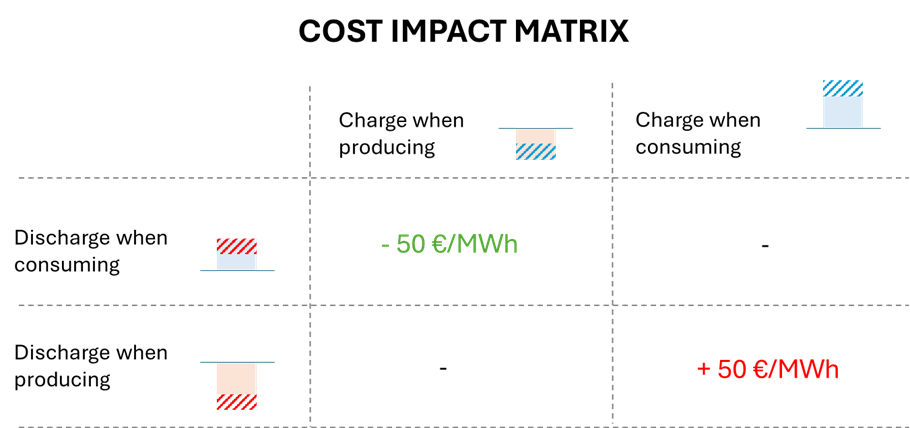
For a typical Belgian company, the total volume-based grid costs for offtake amount to around 40 €/MWh, while injection costs amount to 10 €/MWh. These numbers combine tariffs, supplier margins and levies.
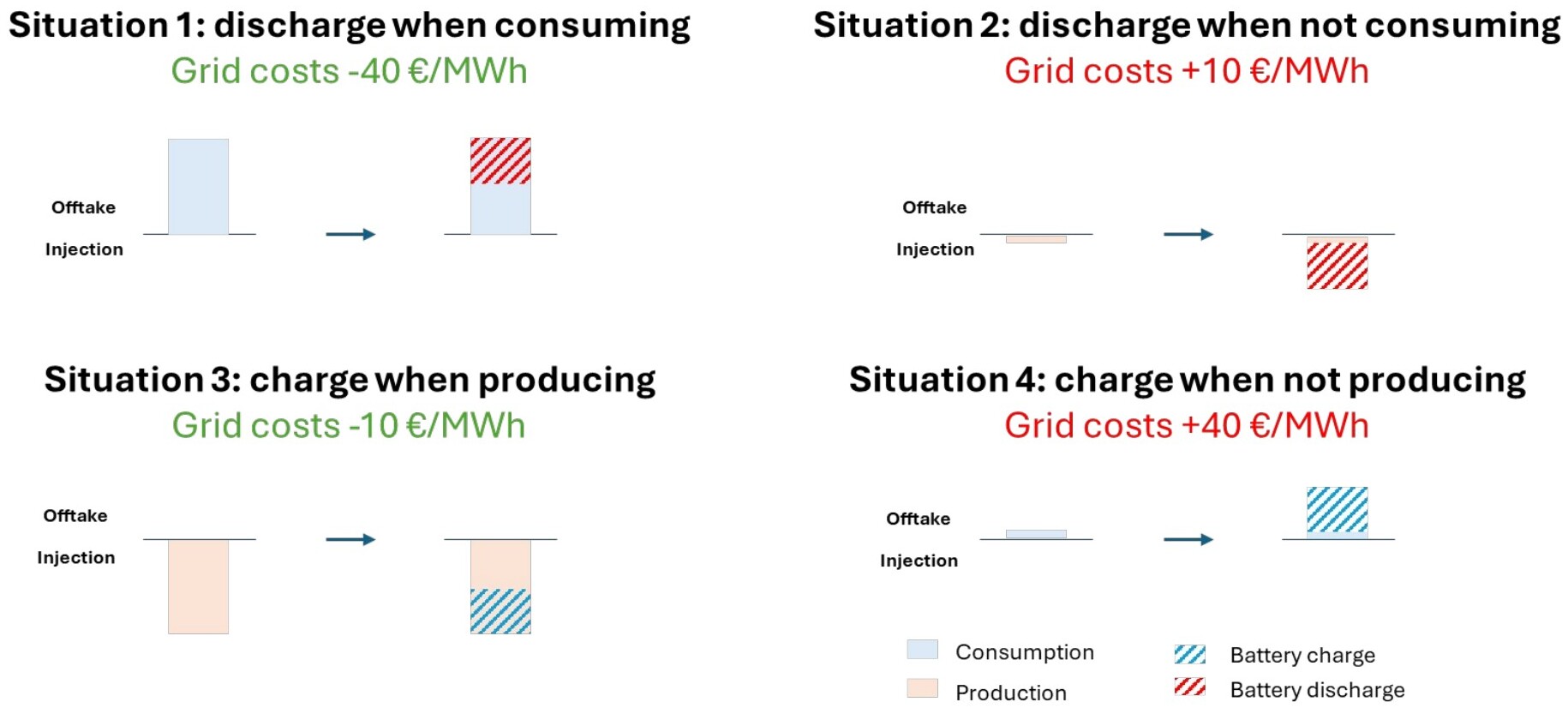
When operating the battery behind the meter, one of four situations appear as shown in the figure below:
- The battery discharges when the site has net consumption, effectively reducing exchange with the grid. In this case, 40 €/MWh of grid costs are avoided by the battery action.
- The battery discharges when the site has net production. In this case, all the discharged energy leads to additional grid interactions, and therefore, additional grid costs of 10 €/MWh.
- The battery charges when the site has net production. In this case, 10 €/MWh of grid costs are avoided.
- The battery charges when the site has net consumption. In this case, all the charged energy corresponds to additional offtake, and the grid costs increase by 40 €/MWh.
By considering full charge-discharge cycles, this can be summarized in the cost impact matrix:
Case Study: Same Market, Different Outcomes
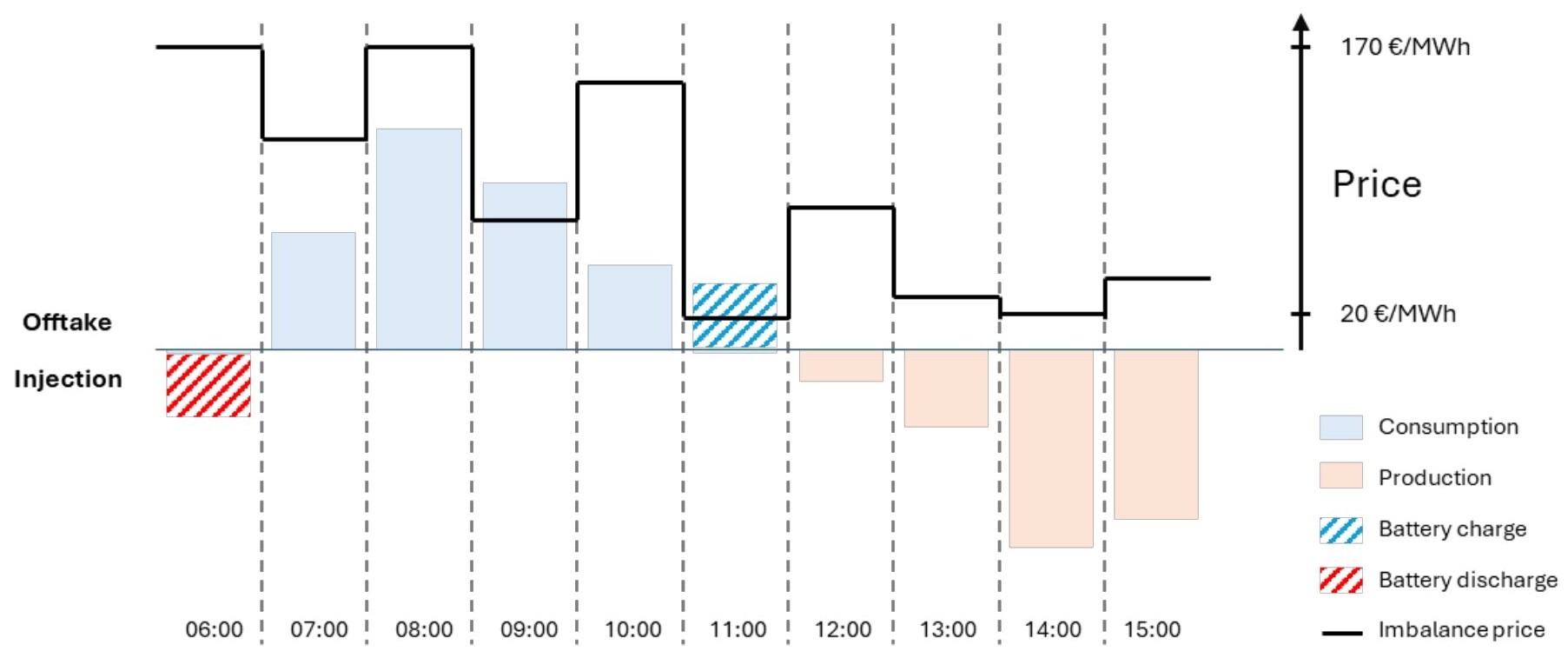
Consider an industrial battery owner with a load and PV production profile as in the figure below. Their battery optimization strategy relies on capturing arbitrage opportunities on the imbalance market.
The imbalance price fluctuations allow for capturing a 150 €/MWh price spread between highs of 170 €/MWh at 06:00 and 08:00, and lows of 20 €/MWh at 11:00 and 14:00. That is a typical price spread for the Belgian imbalance market in 2025.
Case 1: Misaligned dispatch
The battery discharges at 06:00 and charges at 11:00. At both times, the site was not exchanging with the grid and therefore, this situation falls into the bottom right category of the cost impact matrix. Costs increase with 50 €/MWh and have to be subtracted from the price arbitrage revenue of 150 €/MWh leading to a battery value of 100 €/MWh.
Total value: 100 €/MWh
Case 2: Aligned dispatch
The battery discharges at 08:00 when the site was consuming electricity from the grid, and charges at 11:00 when there was injection. At both times, the battery action reduced the grid interaction and as such falls in the upper left category of the cost impact matrix. Costs decrease with 50 €/MWh and have to be added to the price arbitrage revenue of 150 €/MWh to get a battery value 200 €/MWh, double the amount of case 1 with poorly-timed decisions.
Total value: 200 €/MWh
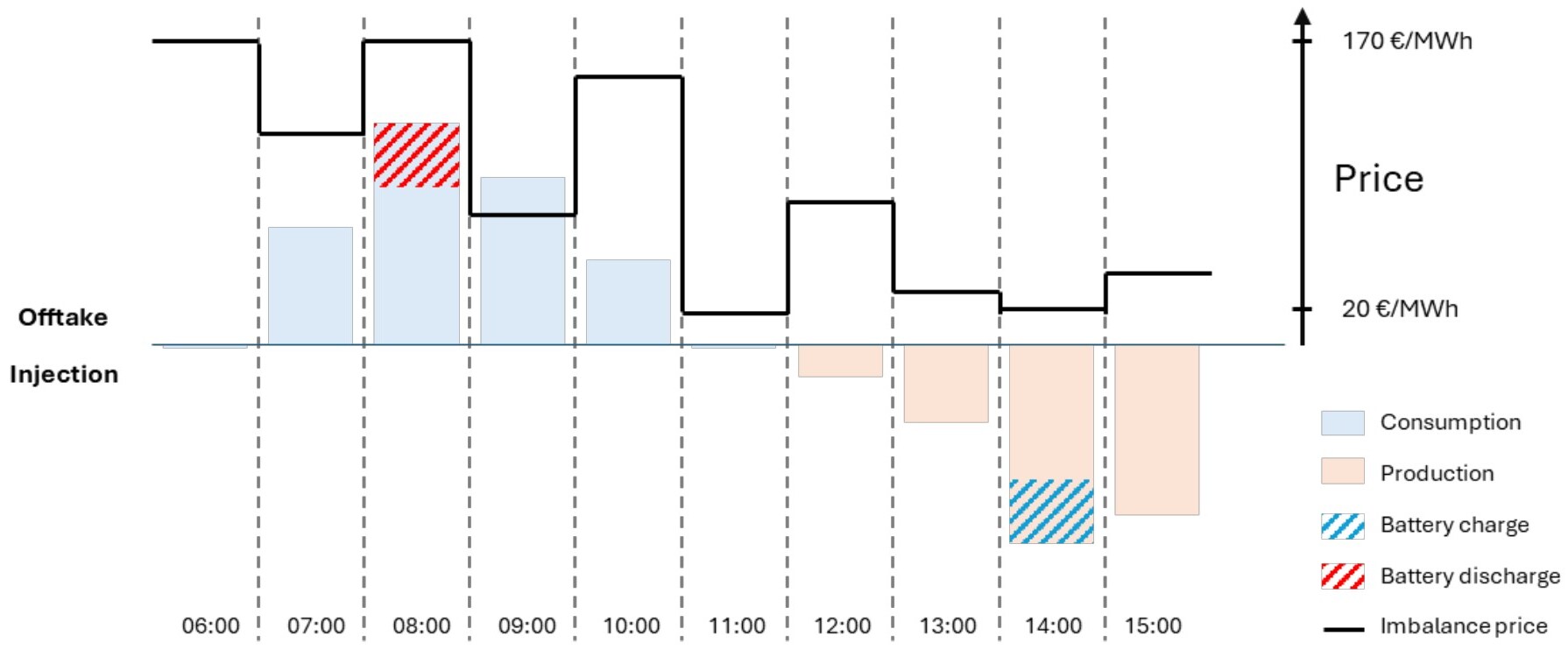
Both cases achieve identical market performance. The difference in value comes entirely from how dispatch aligns with the site.
Implications for Battery Optimization
This result highlights a key limitation of optimization approaches that focus solely on market signals. A battery can be fully optimized for price arbitrage, yet still leave significant value on the table if dispatch decisions are not aligned with the site's energy profile. To maximize value, battery control must consider both:
- external market conditions
- internal site dynamics
This requires the integration of electricity price forecasts, as well as local consumption and production profiles into the optimization process.
Conclusion
For industrial batteries, value is not determined by market trading alone. It is determined by the combination of market opportunities and how battery dispatch interacts with the site's energy profile.
As shown in this case, identical market performance can result in a battery value increase of 100%, depending solely on dispatch timing. Optimization strategies that ignore this interaction systematically leave value on the table.
About Gridual
Gridual develops battery optimization solutions that explicitly account for both market dynamics and site-level energy flows. By aligning dispatch decisions with local context, we ensure that batteries capture their full economic potential.
Curious what this means for you? Discover the full value of a battery with our simulation tool, tailored to your setup.